

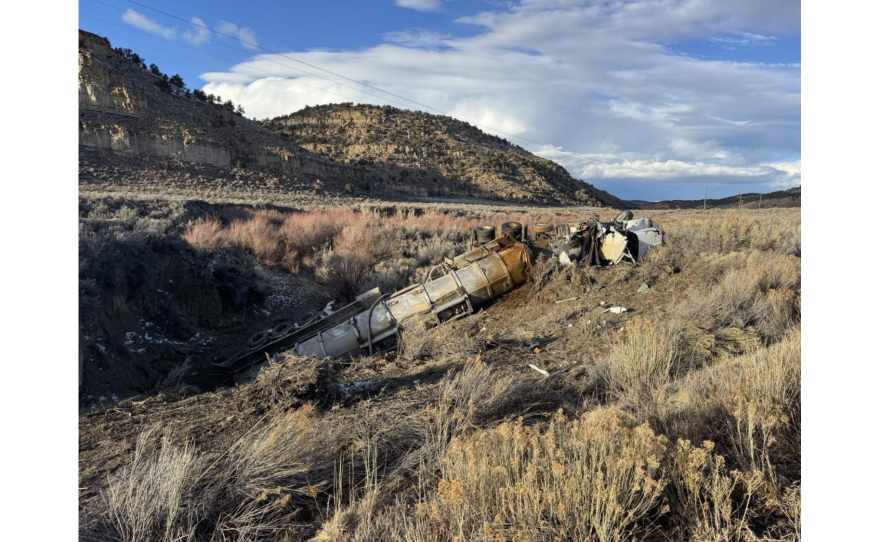


On January 5th, a Humboldt truck wrecked on Highway 139 and spilled approximately 220 barrels of crude oil into West Douglas Creek between Rangely and Grand Junction. The Environmental Protection agencies, Joyel Dhieux says that the spill has impacted a local rancher in allotments.
"The land is managed by the BLM, and it is a grazing allotment. The trucking company is providing alternative water for the cattle that are currently on the allotment. So we've been working closely with the rancher and or in contact with him daily just just to make sure that he knows what work we're doing and we're having as minimal and impact on him and the cattle as possible."
Dhieux says that any lasting impact to the rancher and his cattle would be managed by Humboldt and their insurance company. But oil spill damage is difficult to measure. Crude oil is heavy, and initial cleaning efforts can be concentrated in the areas that clumps together.
"It's really hard for me to speculate on how much we've recovered and and how much more we have to go, and I think to some extent it's a little bit like when you spill something on your kitchen floor and you throw down some paper towels and those first couple paper towels, you get a lot of, the Kool-Aid or whatever you spil,l and then you're trying to mop up the rest of the floor and get the rest that's out there. We're getting pretty close to the point where we're going to be needing to use a little bit more finesse in our cleanup and be doing a little bit more of that spot cleanup."
Dhieux says that the team of 10 to 15 people has had success using vacuum trucks and dams to pick up and prevent the spread of the majority of the oil. But after the clumps are gone, there is still oil coating the vegetation and sinking into the soil.
"At every moment of this response, we are weighing heavily the environmental impacts from our response actions with the environmental benefits of pulling the oil out and, you know, in, in terms of a cleanup, we could come in with an excavator and probably run an excavator up the creek and dig up everything that's been touched by the oil, including all the oil. But that would have a enormous lasting impact on the creek and on the environment. So obviously we're not doing that. "
The consequences of the extractive energy industry are nothing new to Western Colorado. In January of 2013, a failed pressure gauge caused over 10,000 gallons of natural gas liquids to spill into Parachute Creek and poisoned soil and groundwater. Only three years ago, 500 gallons of crude oil rushed into Nine Mile Creek from a drilling waste disposal facility after a retaining wall failed.
Leslie Robinson is a Rifle resident, former journalist, and environmental advocate. She serves as chair of the Grand Valley Citizens Alliance, a grassroots group concerned with oil and gas impacts on the Western slope spills in Garfield County.
Robinson: They're very numerous, especially during the boom time, 2010 to 2016, and unfortunately because most of the oil and gas development happens, they take advantage of the county roads that follow the creeks here in Garfield County, and that's exactly where oil and gas development occurs because hey, they got a county road right to their pad.
KDNK: What was happening between 2010 and 2016 that made oil spills such a frequent occurrence?
Robinson: Natural gas was selling for about $16 a million per BTU, and that's really good money. And we had up to 50 rigs drilling at the same time here in Garfield County during that boom time.
In the midst of some of the most popular skiing and tourism destinations in the continental US oil and gas are still booming. The Garfield County Commissioners are outspoken supporters of drilling, and last year urged the BLM to issue and affirm 15 oil and gas leases within the county and 300 across the state. The local leaders believe that extractive energy is crucial for the local economy and high rates of employment.
Robinson is critical of over-reliance on this industry. She says that towns like Meeker, Craig and Rangely could be at risk of economic failure if the energy companies pull out.
"A barrel of oil is only going for around 50, $60. So nobody's making any money as a company on their resources right now. That means layoffs, that means shutting down.
That means a lot of things and. In rifle's case, we've been really darn lucky that we're part of the Roaring Fork, so that when oil shell or natural gas starts cutting down their production, you know, jobs are still found up-valley. And some people can make that transition or some people just have to move on."
The history of drilling and mining in Colorado goes back to the 18 hundreds and is still deeply embedded in Colorado's Western slope from gold and silver to coal and uranium. It's still a part of the culture for many who call the region home. According to the most recent update from the Environmental Protection Agency, crews have been able to remove most of the oil and are still working to clean up the rest of the spill, which became trapped beneath the ice shortly after the accident.
