Public access radio that connects community members to one another and the world
Play Live Radio
Next Up:
0:00
0:00
0:00 0:00
Available On Air Stations
KDNK has a new app!! Download it at the Apple or Google Play store and tell us what you think!

A lean summer brings bears to towns

A hungry bear walks the streets at midday in Aspen.
Lara Xiaz
A hungry bear walks the streets at midday in Aspen.

By mid-August, Colorado Parks and Wildlife had received more than 6,000 reports of bear encounters in 2026. Lately, everyone seems to have a bear story, including KDNK's Katalina Villarreal, who recently reported on an educational campaign aimed at reducing conflicts.

Katalina Villarreal: I was in my bed, which is in a basement room right next to my backyard. So I heard it trying to get into our trash, which we keep in the backyard right there, and it woke me up. I went outside. I yelled, "Hey, bear, leave," just over and over again. And the bear didn't really react to me, but my mom woke up, and she came downstairs and was like, "What's going on?" I said, "There's a bear outside." My dad came out and turned on the hose and sprayed it, and it finally left, but very reluctantly. It really wanted to try to get anything it could.

Marilyn Gleason: The bears do seem to be especially abundant and destructive this year, enough so that it's been kind of an inspiration for a collaboration with some various governments. And you just did a story on this for The Sopris Sun. Tell me a little bit about the collaboration and who's involved. What's going on?

Villarreal: So the Colorado Parks and Wildlife has gotten over 3,000 reports of bear activity, which is a huge increase this summer from last summer. And due to all of this bear-human interaction, they have coordinated a collaboration with Pitkin County, the City of Aspen, the City of Snowmass Village, and the City of Basalt to help educate the people through pooling together their resources for ads about bears and safety. So you can see them on RFTA buses, in the press, on the radio, because there is such an increase. These bears are trying to find food. They're actually in hyperphagia.

Gleason: So what is hyperphagia?

Villarreal: As everyone usually knows, bears hibernate through the winter, so they have this extreme hyperphagia feeding phase. They try to eat 20,000 calories a day to pack on pounds of weight a day. And this year, of course, we just had a whole series of freezes in the springtime that pretty much knocked out all the forage for bears from the high altitudes to the low altitudes. That and the drought. It makes it a lot harder for the bears to find food resources, and they have probably gone through a lot of their usual spots and have realized there's not enough there, and they've been led down to the urban areas where people are located. And now we're seeing them in our neighborhoods.

Gleason: So who did you talk to, Kat, for this story, and were there any interesting stories that they told you about what's going on with the bears this year?

Villarreal: With the city of Aspen, I spoke with Lara Xais, who is the wildlife coordinator, and she noted that she is seeing bears in the middle of the day, which is usually not seen until late fall when they are extremely active. And she noted how surprised she was by this in the middle of summer.

Gleason: We can move bears around, right? Take bad bears away? Did you discuss this with some of your sources?

Villarreal: Xais mentioned how the old solution used to be to remove problem bears. We've grown from that and realized that there will always be a bear that is searching for food, and really, we have to take responsibility as a whole community collective, which is the CPW's goal, to mitigate bears' interactions with humans by being responsible, especially with our trash and our food trash. Especially right now, when they are so active and they are searching high and low, especially low, for food, we need to take some more precautions and be a lot more thoughtful than we maybe have been in the past.

Gleason: There's a new Colorado law on the books this year, too.

Villarreal: Yes. House Bill 1342. It is increasing the fine for luring bears, and it is lowering the standard of evidence needed for that fine. So if you are in a very active bear area and you leave your trash out, you can be fined $2,000, and if there's a second offense, it goes up to $5,000 if there's any evidence that it was done intentionally to lure bears into the area.

Gleason: And so what does that mean, intentionally luring bears?

Villarreal: Since the standard of evidence has been lowered, they can reasonably say you knew that this was a bear-prone area, and the trash had chicken in it, and it wasn't properly secured.

Gleason: You’re going to have to have a chat with your father about this one.

Villarreal: Yeah. We learned our lesson.

Gleason: Was there anything else that came out of your interviews that you'd like to mention right now?

Villarreal: The CPW and the towns involved are just trying to have the messages about bear safety be consistent and coordinated across the board, so that everyone is getting the same information and getting educated on how to go forward during this time when bears are more active and human- bear conflicts are on the rise.

Gleason: Katalina Villarreal, thank you for reporting on this for the Sopris Sun and for having this conversation with me about it as well.

Villarreal: Thank you so much for having me.

Marilyn Gleason is the graduate of CU Boulder's journalism school. She started her radio career in the Roaring Fork Valley at KAJX in Aspen, then came to KDNK in 2000 as the station was in the early stages of forming a local news program. Marilyn returns to direct a growing news team at KDNK.
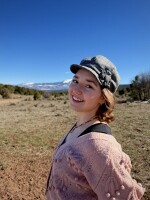
Katalina Villarreal, born and raised in Carbondale, reports with KDNK for the 5-6 evening news. She also pitches and produces stories for the air and writes with the Sopris Sun newspaper. Katalina believes in the power of education and being informed. Uplifting the community is her priority as a human and journalist. She will graduate from Central Washington University's online English: Professional and Creative Writing program December 2026 and plans to stay in the valley pursuing a career in journalism. Katalina is proud to be a part of KDNK's news department and hopes to grow with it.