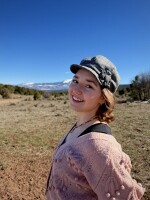
With our KDNK Fall Fund Drive, we have our KDNK Nonprofit Connect. Mike Lemmer is joined by Becca Schild, the executive director of the Roaring Fork Outdoor Volunteers.
Mike Lemmer: Becca, thanks for coming in this morning.
Becca Schild: Thanks so much, Mike. How are you doing?
Lemmer: Doing great. How are you this morning?
Schild: I am doing well.
Lemmer: So, Roaring Fork Outdoor Volunteers. What's it all about, for people that are not familiar?
Schild: Sure. So we have been operating in this valley for 31 years to make sure that we bring our community together to care for shared outdoors. So that means trails, open spaces, fire-prone areas, and we also have a very large youth program where we work with local youth to inspire environmental and outdoor stewardship.
Lemmer: How long have you been involved, and what's your role with it?
Schild: I've been the executive director, and I've been here for seven years. My family and I actually moved over from Leadville. I heard on the radio and as I was driving up that you were giving Leadville weather. So we moved over here, and it's just been a really wonderful place to land and a great place to raise my family.
Lemmer: What made you wanna become involved with Roaring Fork Outdoor Volunteers in the first place?
Schild: I have a background in outdoor education and environmental studies. I actually researched volunteer stewardship for my PhD dissertation, which I know sounds kind of archaic, but I was really interested in how we get the community involved to help solve some of the environmental problems that we see today. And volunteer stewardship spoke to me because it's so hands-on, and it's so direct in terms of the impact that people can make. So when this job opened, I applied and it seemed like a great fit and I haven't really looked back.
Lemmer: And you are mainly volunteer-powered then? What kind of opportunities do people have to volunteer with you guys?
Schild: Well, we actually have a staff of fourteen; I think that sometimes our name is misleading. And what that does is it helps provide opportunities for over two thousand volunteers to engage in hands-on stewardship. We have a professional trail crew that spends most of their season actually in the wilderness, and volunteers join them on backpacking projects, and so they'll spend up to seven days in the Maroon Bells doing high alpine trail work. We also have volunteer projects right in town. So just at the beginning of this month, volunteers helped out here in Carbondale at Riverfront Park removing invasive species. So we have a really wide array of opportunities for volunteers from easy family-friendly to very physically strenuous. We're nearing the end of our season, and this coming weekend we have a project up at Redstone on McClure Pass Trail. Pitkin County is building a single-track trail up there, and so volunteers will help finish that project. And then on Sunday we'll be in the Glenwood Canyon working on the Jess Weaver Trail and helping with some of the post-flood, post-fire recovery that's still going on. So those are projects coming up this weekend, and you don't have to have any experience. You just definitely assess kind of what you're up for as far as physical challenge. But we provide everything that you need, all the way from gloves to tools to training, so it's a great way to get outside during the fall weather.
Lemmer: Definitely. And speaking as someone who enjoys all these great trails, we really do appreciate the work you guys do. Somebody's gotta do it.
Schild: Yeah. Thanks so much.
Lemmer: In addition to the trail stewardship, you guys are looking to expand into other conservation-related activities as well?
Schild: Yeah, we've done restoration projects since the very beginning, but when we did our strategic plan in 2020 and then renewed that plan in 2026, we emphasized the need to increase our capacity to do restoration work and fire mitigation work; we've really built up a skill set and partnerships to do that. So I'll give you an example. Drought has been on everybody's mind, and in August, we had 41 volunteers go all the way out to the Thompson Divide to help build and install beaver dam analogs in the Middle Thompson Creek Watershed. And so they installed 41 beaver analogs with the Forest Service, and we had Wilderness Workshop as a partner. What that will do is mimic what a beaver dam does for the watershed and help revitalize that riparian zone. So we have a lot of different projects like that, and I'm really excited about that because there's a lot of restoration opportunities, and I think people feel their spirit is lifted when they're able to restore the land alongside other people.
Lemmer: Is the beaver dam analogs kind of a new initiative in the area here? Are we gonna see more of that kind of thing?
Schild: I think so, yeah. The back end of it is there needs to be a lot of assessment of the opportunity as well as whether it's on federal land. It has to go through the NEPA process. There are some policy or procedural things that need to be addressed, and I think a lot of that work has been done. There was actually an article in the paper about how Colorado is in support of bringing beavers back to local habitats. So I think that we will see a lot more of that in the future.
Lemmer: That's great and good work there as well. Now, in addition to the projects you have coming up, do you have a volunteer appreciation party in the works here, too?
Schild: Yeah. Every season, we like to honor our volunteers, partners, sponsors, and donor community. We have a party on October 15th at CMC Spring Valley Campus. And that's just a great way that we celebrate our community. We have volunteer awards, so we have Volunteer of the Year, Rookie of the Year, just different kinds of accolades that we like to hand out, prizes, and just kind of do a season wrap-up.
Lemmer: And for people interested in becoming a volunteer or seeing how they can help out with Roaring Fork Outdoor Volunteers, where can they go to learn more?
Schild: Yeah: www.rfov.org is the best place to start, and you can look at our calendar and different programs that we have. We have group projects that you can reach out and schedule your own custom project either for your local business, or we've had people organize birthday parties around volunteering. So there are a lot of different ways to get involved in addition to those public community projects.
Lemmer: We're speaking with Becca Schild of Roaring Fork Outdoor Volunteers as part of our KDNK Nonprofit Connect. Becca, and all nonprofits around the area, we're kinda all in this together. What does community radio, and nonprofits overall, mean to you personally?
Schild: Well, as a community-powered nonprofit ourselves — and I'm reading your shirt: the "heartbeat of the radiosphere" — we really represent what the community is looking for and the community's needs, and that comes from local residents and visitors who understand community values and are motivated to give back. And I think that's the most important part of a healthy community: community members who are, you know, willing to be part of something bigger than themselves, and community radio is a great example of that as well.
Lemmer: Exactly. We're all in it together.
Schild: Yeah.
Lemmer: And together we got this.
Schild: We do.
Lemmer: Becca, thanks so much for joining us. Any final thoughts or words of encouragement you'd like to share?
Schild: Well, I hope that your fund drive goes well, and next season we'll have a whole slate of volunteer opportunities. So, keep us in mind for the future, and if you can show up this weekend, that would be great as well.
Lemmer: All right. Thank you again for joining us, Becca.
Schild: Thanks so much.
It is KDNK's Nonprofit Connect, a part of our Fall Fund Drive. Mike Lemmer for KDNK News spoke with Becca Schild with the Roaring Fork Outdoor Volunteers. Check out their website, www.rfov.org.