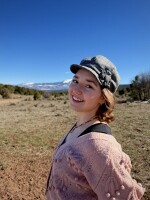
MIKE LEMMER: Our fall membership drive continues, and as part of that, it's time for the KDNK Nonprofit Connect. Joining us in studio this morning from the Pauline Schneegas, a wildlife foundation in Silt, we've got Nanci Limbach in studio. Nanci, thank you for coming in.
NANCI LIMBACH: Thank you for having me.
LEMMER: Yeah. So the Pauline Schneegas Wildlife Foundation, tell me what it's all about.
LIMBACH: Well, I started it, gosh, almost 45 years ago. Started out small in the backyard and grew, but our main purpose is to take in injured and orphaned wildlife and get them back to the wild as soon as we possibly can.
LEMEMR: Excellent, and a big part of that, especially this year, has been bears, right?
LIMBACH: Yes, there's a lot of those. We have 34 of them in our place currently. Our record one year was 39, so we're not quite there. Somebody said we don't want to break that record.
LEMMER: And where are they all coming from, the ones that you have? Are they mostly from the Silt area there?
LIMBACH: We've got some from up valley. We've got some from Vail, down by Junction, Meeker, Steamboat, so pretty much the whole Western Slope.
LEMMER: And what is the process to rehab them and get them so they can go back into the wild?
LIMBACH: Most of them we're getting are, like, really small. They only weigh about 10 to 20 pounds, and so it's basically fattening them up mostly, but you have to start slowly with them. It's like taking an anorexic. You can't just shove food in their face. It can actually kill them, so you have to slowly start them on their diet. And then we worm them along the way and get them as fat as we can, and then we put them into hibernation. We're already starting that process. We have an upper valley bunch of pens and things, and they're going up into there. It's about 8,000 feet elevation, so they hibernate sooner.

LEMMER: Okay. When they come to you smaller and underfed like this, how long of a process is it? How long are they usually with you for?
LIMBACH: They'll stay until... well, if we put them into hibernation, we may have a couple that aren't going to get fat enough. They have to be at least 50 - 60 pounds to survive a winter. So we'll determine that as they get toward fall further into the winter and see. But hopefully by the end of November, most of them will be in hibernation, and then we take them out of our dens in February, and they get a nice snowmobile ride up into the mountains. And CPW has built dens for them. They're usually snow caves, and we put them in there, and then in March and April, they just come out like normal bears.
LEMEMR: Okay. So they're pretty much semi-hibernating then when you put them back into the wild?
LIMBACH: Yeah, and they'll be in their dens, and they sleep, but it's not a true hibernation because they can be woken up and all, so they'll be active when we move them from our dens to the transport cages.
LEMMER: Is there anything else you have to do to kind of prepare them for the wild? You gotta teach them anything or do anything particular?
LIMBACH: Just the, you know, the climbing and digging, and we put logs where they can dig for bugs and learn to do that. But so much of it is just inherent in them to do. Like, they don't have to be taught how to make a den. Sometimes they'll take them out in the fall. I think we have one yearling bear that they'll be taking out during a blizzard, and they'll be down timber, and the bear will just climb under a log and let the snows come.
LEMMER: Nice. What's your favorite part about working with bears like that?
LIMBACH: Seeing them get released.
LEMMER: Right.
LIMBACH: That's probably the best part.
LEMMER: Being able to go out there on their own.
LIMBACH: Yes, and being able to get back out in the wilds and know everything. In the original years when I started doing this, everything was radio collared, so we knew what happened to every bear, and that was kind of exciting to know that they actually survived the whole process, and most of them went on to being adult bears.
LEMMER: But you don't do the radio collars anymore, just kind of let them go and hope for the best?
LIMBACH: They sometimes do if they're doing studies. Like in Aspen, they did a study to show where the bears were during bad years like this, which was the neighborhood dumpster, but yes. And then they did one in Durango. But other than that, they're microchipped, and they just track them that way.
LEMMER: Now, do you have other animals there besides bears? What kind of other menagerie do you have?
LIMBACH: We have a few foxes that we got as pups, and I have a little bobcat kitten. It was found in Eagle. For some reason or other, it was at somebody's back door, and it was only about two months old. And so it's working on learning to be a bobcat, and it's not a very nice cat, I can tell you that.

LEMMER: Who gets to teach him how to be a bobcat?
LIMBACH: That's my job, yes. Hasn't been a problem. The dude seems to halfway know what he's doing already for such a little dude.
LEMMER: Yeah, he's probably like, "I know what I'm doing. Leave me alone."
LIMBACH: Yeah, yeah.
LEMMER: And with all of the other animals, it's kind of the same thing? They're all kind of underfed and need to be rehabbed and fattened up basically?
LIMBACH: A lot of them, you know, like the bears and things, we got them for various reasons. Some of the mothers were put down because they either broke into houses or got into trouble. But we're seeing a lot. There was the one here in Carbondale where the mom was hit by a car, and we ended up with two cubs from that. And some have illegally been shot by residents in neighborhoods, and so we've ended up with those. Others, when they're bad years, the mothers have to know whether they have enough body fat to survive themselves, and a lot of times they'll just abandon their cub.
LEMMER: Awe.
LIMBACH: It's kind of sad, yes.
LEMMER: Now, are there cases where they can't be returned to the wild for some reason, and what do you do in that case?
LIMBACH: Our laws in our state are all animals have to be raised for release. If they can't be released, they have to be euthanized.
LEMMER: Okay.
LIMBACH: So, that is a big push to get them out there.
LEMMER: Yeah. Do your best then to do everything you can – save their lives, basically. We're speaking with Nanci Limbach from the Wildlife Foundation in Silt. Now, Nanci, you had a group of kids there this week then too. Do you do that a lot? Do you get, like, field trips that come in?
LIMBACH: We do a lot of field trips with the kids, and it gets kind of chaotic. The bus shows up, and all these little munchkins come out And get excited to see the animals. And it's environmental programs and on dealing with wildlife, and we try to start with them being young in hopes that by the time they're adults, they can follow a few rules when it comes to living with wildlife.
LEMMER: What does it seem like the kids are the most interested in when they come to visit?
LIMBACH: Okay. It's kind of funny. If you do preschool kids, they're interested in the chickens and things like that. It's really weird. You'll have all these interesting things they can see, and when they say the thank you to you, "I liked the chicken," it's like, really? You liked the chicken?
LEMMER: You gotta like chickens, though, yeah.
LIMBACH: Yeah. But they get to play with one of the wolf hybrid dogs we have, and they like that part, too.

LEMMER: And then as they get older, they kind of get into different animals other than just chickens?
LIMBACH: Yeah, it's more into, you know, you've got the wolf crew that's really into the wolves and things like that. And we've got some foxes they can see that were born in captivity, so we kind of explain about them and they all wish they could see the bears, but anything that's in rehabilitation does not get seen by the public.
LEMMER: Right. Do you take questions from the kids, too? What are some crazy questions you've heard over the years?
LIMBACH: Well, they kind of split around. We try to keep 25 at a time in each different group, and so there's like two or three stations that they do. One is seeing animals, and then the next is in the classroom, and that's where you can do the question and answers and things. But no, I think the worst is when you've just told them it's illegal to have raccoons as pets, and you'll have a kid go, "Uh, we have one." "Really? And you just told me that. Okay."
LEMMER: Yeah. I just told you that's illegal. Shh...
LIMBACH: Or, "My dad's had them," this kind of stuff. They really will tattle on their parents.
LEMMER: They don't mean to, though.
LIMBACH: No.
LEMMER: Over all these years of working with animals, what would you say is the, the funniest story that you have, or the most harrowing story? Or what do you like to tell people the most about what it's like?
LIMBACH: Well, there's a lot of different one. I think one of the most unique, and this had to do with a bear. We don't usually get adult bears, but they were trying to trap three cubs from a mom, and they couldn't get them, so they brought her to us. And she laid in the crotch of an old apple tree just crying. It was sad. It was like, I don't know if they're gonna get your kids. And she was just really depressed. After three days, they finally caught them, and they brought them, and we put them in the compound with her. And the first thing she did was jump out of the tree, and she smacked every one of the cubs and rolled them into the fence. And we're like, "Geez, is she gonna kill them?" And then she climbed back up in the tree and cuddled all three of them and let them nurse and put her paws around them. And it's like oh, that was the mother who lost their kid in the mall, "Where have you been?"
LEMMER: Yeah. Told you to stay by me.
LIMBACH: Yeah.

LEMMER: Yeah. Now, Nancy, are there opportunities for people to volunteer to help out with what you're doing there?
LIMBACH: We do take in volunteers. It's off our website. There's an application to fill out, and the state has this questionnaire thing that the volunteers are supposed to study and learn with things. And they have to keep track of their hours. We turn those into CPW, and it's pretty regulated. They don't get to help a lot with the stuff that's in rehab because we try to assign, like, one person. And I was a certified vet tech, and I have two techs that work for me. So usually they're the ones assigned to those particular animals, 'cause you don't want them used to 50,000 different people.
LEMMER: Right. And for people that maybe don't have the time to volunteer, are there fundraiser opportunities? Any ways they can donate to you for what you're doing?
LIMBACH: We've had people do that, and it's been really exciting this last month with the bears. We just had a work crew of people that they didn't even know each other, but one lady put it together, a bunch of people, and they went up in the hills at our upper place and helped build some bear cages. So met some really nice people there, and that's always exciting. And then food drives is probably what people are working on now, is collecting food. Right now we're feeding two 1,100-pound crates of peaches every week to the bears, and unfortunately there aren't any apples in the Western Slope this year 'cause they all froze, so people are shipping them in from Texas. So that's my next thing, is to find a semi to bring us apples.
LEMMER: Nice. So every little bit helps. Any volunteer or fundraising or anything people can do? We're kind of all in this together, right? All of us nonprofits here in the current economy.
LIMBACH: Yeah.
LEMMER: Nanci, what does community radio mean to you? We do appreciate you coming on. What's it mean to you to, to have an access to community access radio like this?
LIMBACH: Well, I think this is exciting, you know, not only do you do the highlights on nonprofits, but it's highlights on our neighborhood, our community. And other news is pretty much out of Denver, and we don't exist on the Western Slope, so it's always nice to hear what's happening locally and find out things that you can go do and participate in that you wouldn't know about otherwise.
LEMMER: Exactly. That's what we're here for. We do thank you for joining us, Nanci. Where can people go to learn more about the Wildlife Foundation?
LIMBACH: You can look up our sites at the Pauline Schneegas Wildlife Foundation. You can look that up on .org, and it has a whole link to different things.
LEMMER: Excellent. Thank you so much for coming in this morning.
LIMBACH: Thank you.
LEMMER: That's Nanci Limbach with the Pauline Schneegas Wildlife Foundation in Silt as part of our KDNK Nonprofit Connect.