


This year marks the 250th anniversary of the United States, and the 150th anniversary of Colorado. Both the federal and state governments have established commissions to organize festivities.
But not all of that history is cause for celebration.
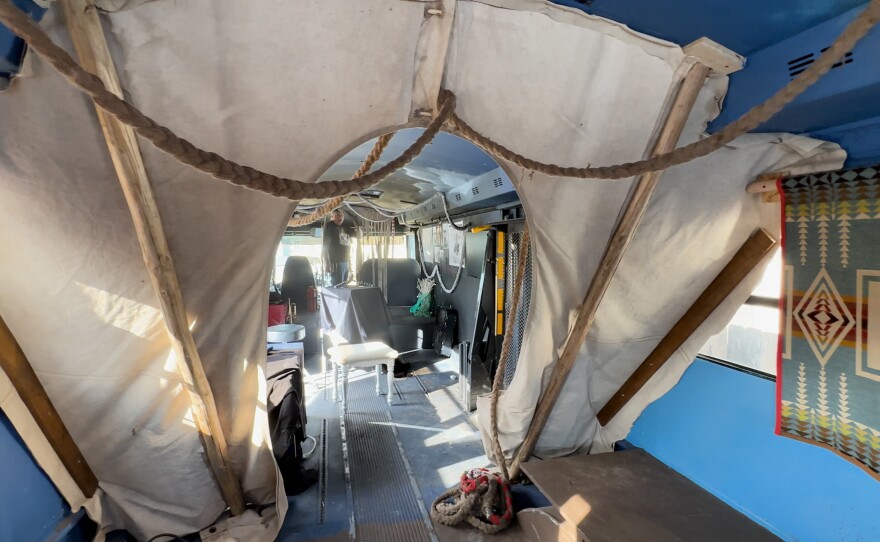
A new, mobile history and art project called the Breathing Healing Bus aims to bring focus to the experience of Indigenous communities in Colorado.
Stewart Huntington is the director of video journalism at ICT, formerly Indian Country Today. He interviewed the people behind the Breathing Healing Bus project, and spoke to Aspen Public Radio's Sage Smiley about his reporting.
This conversation has been edited for clarity and length.
Sage Smiley: Stewart Huntington, thank you for joining me today to talk about your reporting.
Stewart Huntington: Thanks for having me.
Smiley: So for a bit of context, this is the 250th year of the United States, if we're counting from the Declaration of Independence, and the 150th year of Colorado. There are state and national commissions that are setting up celebrations and events. This has been in the works for a while, but one of the issues with these commissions is that they've started out from a place of leaving out some of the United States history. Can you speak a little bit about that and how that kind of enters into, crosses over with your reporting?
Huntington: The big thing that came up when people started talking about a celebration – and it certainly came with the Trump administration making a big deal out of wanting a big celebration of the country's 250th and then that bled over a little bit into the thinking on Colorado's 150th.
And of course, for Native communities, Native nations in this country, there isn't a lot to celebrate when you look back at the history of land usurpation, among other things, and that played out here in Colorado as well.
Smiley: So within that context, can you tell me a bit about how this bus that you're reporting on, this bus project to complicate the narrative on the history of the United States and the history of Colorado came about?
Huntington: Yeah, I heard about the Breathing Healing Bus, which is a mobile exhibit that tells what the people who built it are calling the truth about Colorado's history. This is focused on the Native experience, the Indigenous experiences in the state of Colorado. And the bus is a mobile exhibit. It's got audio and visual elements. It's got artwork, and it tells the story of the Indigenous experiences in the state.
It grew in large part out of the Truth, Restoration and Education Commission, which was a comprehensive study of the Native nations in Colorado's history. It was released in 2023, it focused on the 10 tribes, or 10 federally-recognized tribes with ancestral ties to what is Colorado today. And of course, there's only two reservations in Colorado in the far southwestern portion of the state. But just as in modern times, where most of the population lives in the Front Range, most of the original inhabitants lived on the front range. They're all, of course, gone today.
And so this commission said, 'What happened? What is the actual timeline, and what happened to all of these nations that were driven out of the state?' And so that work led directly into this idea for telling these truths at this juncture, where there's a focus on the country's history and the state's history, and this is a parallel focus on the Aboriginal history of what is Colorado.
Smiley: What did you hear from the Indigenous artists and activists that you spoke to in the reporting process for this story? What are they hoping people learn, people leave with, people understand through this bus project?
Huntington: I think that comes right from the title, Sage, which is 'Breathing, Healing.' It's the Breathing Healing Bus. And everybody understands — everybody who built this, the kids, there were some kids involved, and some scholars involved, and artists — everybody understands that there's some difficult truths. There's the Sand Creek Massacre here in Colorado. There's the eradication of the buffalo, which was designed to remove the to to undermine the economy of the Native nations.
And even though the history is difficult, even though some of these facts are [dark], the focus of this project is healing. The folks behind it want the truth to be told, but not in a way that re-traumatizes or triggers people, but to bring people together, bring the state together and say, 'Hey, we have a troubled part of our history. Let's know it. Let's own it, and let's see what we can do or go forward to make these existing Native communities healthy, healthier, but also maybe to share in the broader community some of the ideas: we are all related. We need to take care of the streams and the planet and the other animals and creatures on the Earth, maybe some of those ideas are good ideas that can spread in a broader way.'
Smiley: By nature, a bus is mobile. The idea of this project is to take it all over the state of Colorado and help educate all of the communities they can in Colorado. So where's this bus going? Where is it started? Where is it headed? What's the plan?
Huntington: The plan is to start in the two reservation communities in the far southwestern part of the corner of the state, and then travel as far and as wide as they can, including into the Roaring Fork Valley. Plans are underway now to find the right time and place to bring this into the Roaring Fork Valley. This is a great opportunity to take an honest look at who we are as a country. Are there things that we can do better, and are there lessons from other communities that we can learn?
Smiley: Thank you very much for your time and for sharing your reporting.
Huntington: Thank you, Sage.
Read or listen to Stewart Huntington's report on the Breathing Healing Bus here.
Copyright 2026 Aspen Public Radio