


Radio Physics
Tune into Radio Physics at 4:30pm on the third Wednesday of each month.
Radio Physics is for everyone! You don't have to be a scientist or even an aficionado to be fascinated by the questions and answers that you'll hear on KDNK. Radio Physics is a collaboration with top high school physics students from Aspen to Rifle, the Aspen Center for Physics, and KDNK Community Radio in Carbondale. Students interview one of the more than 1,000 physicists who visit the Aspen Center for Physics every year.
Latest Episodes
-
 On this episode of Radio Physics, Sasha Fielder sits down with renowned theoretical physicist Csaba Csáki to explore the frontiers of modern particle physics.From the high-energy collisions at the Large Hadron Collider to the silent mystery of the cosmos, this interview breaks down the complex "math of the universe" into a conversation for the curious mind. Listen to Radio Physics on KDNK.org every third Wednesday at 4:30pm.
 -
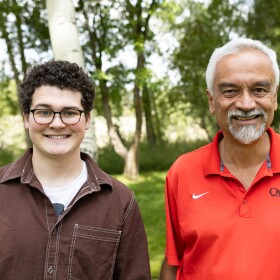 This time on Radio Physics, intern Henry Billinghurst talks with theoretical physicist Krishna Rajagopal, exploring one of the most extreme states of matter in the universe: “hot quark soup,” or quark–gluon plasma and how scientists recreate this early-universe matter using powerful particle colliders to briefly produce tiny droplets of this ultra-hot, liquid-like plasma. They discuss the physics of the early universe, the behavior of matter under extreme conditions, and how modern experiments help us understand the origins of everything around us. Listen to Radio Physics on KDNK.org every third Wednesday at 4:30pm.
 -
 In this episode of Radio Physics, hosts Jack Kravitz and Sasha Fielder sit down with physicist Ryan Foley. The episode dives into gravitational waves, the dramatic collisions of neutron stars and the black holes they can create and how neutron star mergers help scientists measure the expansion rate of the universe, offering new clues about the cosmos’s past and its ultimate fate. Listen to Radio Physics on KDNK.org every third Wednesday at 4:30pm.
 -
 On this episode of Radio Physics, astrophysicist Cole Miller, joined by intern Sasha Fielder, discuss black holes—from the formation of early, very massive black holes to black holes orbiting black holes and the gravitational waves they produce, as well as multi-messenger astronomy, neutron stars, tidal forces, and discoveries from LIGO and VIRGO, along with insights gained from working with NASA’s NICER mission. Listen to Radio Physics on KDNK.org every third Wednesday at 4:30pm.
 -
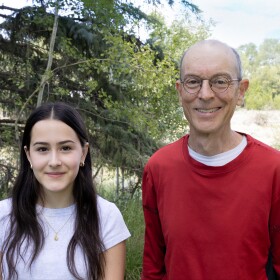 On this episode of Radio Physics, summer intern Alice Lebedev-Migdal interviews physicist Ned Wingreen. Ned's current research focuses on modeling of bacteria, bacterial communities, phages, and other microorganisms, as well as studies of intracellular phase separation, and topics in immunology. Listen to Radio Physics on KDNK.org every third Wednesday at 4:30pm.
 -
 On this episode of Radio Physics, physicist Flip Tanedo is interviewed by interns Shen Harman & Alice Lebedev-Migdal. Flip Tanedo builds models of dark matter. He is spending his time at Aspen Center for Physics thinking about ways in which dark matter can explain the mysteriously gigantic black holes that have been puzzling astronomers for the past 10 years and is also writing a textbook on linear algebra for physicists. Listen to Radio Physics on KDNK.org every third Wednesday at 4:30pm.
 -
 On this episode of Radio Physics, intern Shen Harman interviews physicist Gordon Baym. Listen to Radio Physics on KDNK.org every third Wednesday at 4:30pm.
 -
 On this month's Radio Physics, summer intern Shen Harman interviews Physicist Clifford Johnson. Tune into Radio Physics at KDNK.org, every third Wednesday at 4:30pm.
 -
On this month's Radio Physics show, summer intern Josie Jacobs speaks with physicist Monica Jinwoo Kang.
-
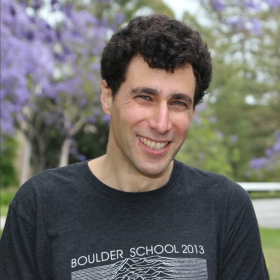 On this month's Radio Physics show, summer intern Colby Vanderaa speaks with physicist Gil Refael.


